Showing posts with label GMOs. Show all posts

Monday, July 28, 2014

Fiesta del Maiz - Xilonen Ceremony

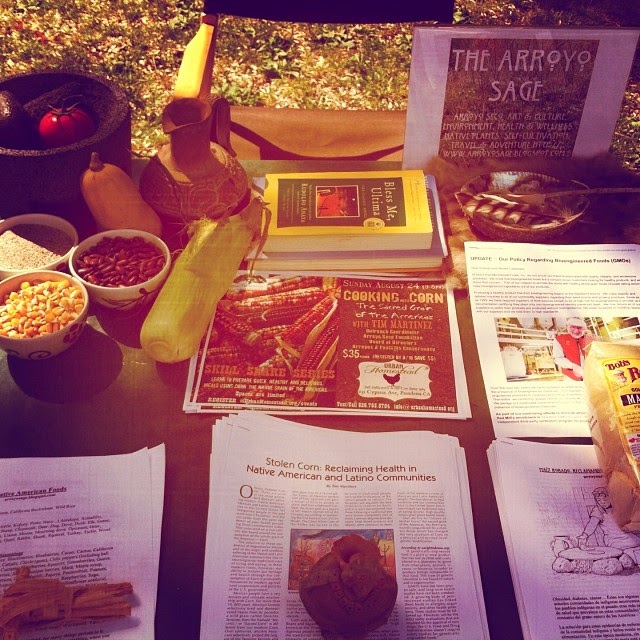
I attended the Fiesta del Maiz - Xilonen Ceremony on Sunday at Prospect Park to distribute articles, promote my upcoming cooking class (a fundraiser for the Arroyos & Foothills Conservancy), and to enjoy this celebration of traditional, non-GMO corn.  I had some interesting conversations, and shared the park with organizations doing great work to improve our environment and society.


“Fox” Orozco, an Aztec Dancer, was one of the first people to greet me.  I took in the smell of the white sage he was smudging to "start the day off right,” and gave him a brief description of my writings promoting the importance of returning to a traditional diet.  When I  visited his booth later in the day, I was grateful to hear that he really appreciated my article, Stolen Corn.

SLOLA’s beautiful heirloom corn.

The Seed Library of Los Angeles was an organization that I had just learned about, and I was excited to chat with them.  SLOLA’s mission is to preserve genetic diversity and increase food justice and food security by saving heirloom seeds, and by creating a local community of seed-saving gardeners.  A beautiful selection of native corn seeds were on display at their table, and David King, SLOLA’s board chair, was knowledgeable and enthusiastic about sharing their great variety and diverse culinary uses.


It was nice to have my friend Samyrha stop by and visit, along with one of her friends from the nearby community garden Proyecto Jardin.  They had just harvested some beautiful, heirloom corn from their garden - huge and multicolored.  We shared a pot of quinoa and ate from improvised corn-husk spoons as we talked and caught up.

Samyrha hanging at the Arroyo Sage table.

I was happy to find another friend, Dennis Uyat, setting up a table for Comida No Bombas next to me.  Dennis is an old garden-club buddy from Pasadena City College, and another member of Proyecto Jardin.  He’d told me before of his work with  Comida No Bombas, but I became very impressed after learning more.

Always good catching up with Dennis.  Such a good dude!

Comida No Bombas is a collective of young people who deliver free, vegan meals to folks in need - by bicycle!  They use food that otherwise would have been wasted, and wrap it in biodegradable packaging.  While other organizations provide food of questionable salubrity, in styrofoam packaging, with plastic utensils which end up as litter on the ground - Comida No Bombas seems to have all the right bases covered.  Their model benefits our environment, our health, and our society - and should be replicated in every city, nationwide.


I enjoyed other interesting conversations with people throughout the day - all to the backdrop of Danza Mexica Cuauhtemoc’s dancing and ceremony. A volunteer with the Seed Library shared how a family history of farming inspired her to preserve biodiversity. Another woman shared her knowledge of natural, Mexican remedies for colds and injuries.  Anet Aguilar, of the Facebook page Yo Soy Maiz, discussed with me the importance of identifying sources of non-GM masa and corn for the Latino community.


The issue of preserving the genetic integrity of natural, non-GM corn is an issue of preserving cultural identity.  After learning the disadvantages of genetically modified corn, I resolved to avoid it as much as possible.  Unfortunately, this also meant avoiding and losing a part of my culture. Fond memories of my Nana making tamales, and of eating my favorite ones (tamales dulces!) returned to me.  Before finding non-GM alternatives, I felt a sense of loss that I would not eat those foods again.


Attending the Xilonen festival left me encouraged that a desire to preserve the living heritage of natural, non-GM corn is growing.  Embracing the health-giving foods of our ancestors, voting with our lifestyle, and opting out of the industrialized food system in favor of sustainable agriculture has the power to impact our health and environment for the better - and in ways that are far more powerful than casting a vote at the ballot box.

Monday, December 23, 2013

Stolen Corn: Reclaiming Health in Native American and Latino Communities


Obesity.  Diabetes.  Cancer.  These are some of the most prominent diseases afflicting modern Native American, Mexican, and Latino communities in the United States.  Yet indigenous people in the past were much healthier, and did not suffer from the same epidemic of poor health that pervades these communities today.  They subsisted on a macrobiotic diet based around the consumption of the whole grain of the Americas - corn.

The solution to these epidemics of degenerative disease and of the tragic and needless suffering of the Native and Latin American communities lies in returning to our traditional ways of living and eating.  In these modern times, however, our ability to reclaim our heritage and health through the consumption of corn is profoundly threatened by modern agricultural corporations and by the policies of the U.S. government.


Mexican people have a very ancient and intimate relationship with corn.  For over 10,000 years, Mexican farmers selectively bred and domesticated maize from it's ancestor, a wild grass called teosinte.  Teosinte, from the Nahuatl "teocintli," or "sacred corn" is very different from modern corn.  Over the centuries, ancient Mexicans selectively picked the largest of the teosinte kernels and bred from it the first ancient forms of maize.  This domesticated whole grain spread throughout North and South America.  It made civilization possible and was bred with incredible diversity, allowing for it's adaptation to numerous climatic conditions.  As whole grains elsewhere in the world, corn took it's place as the primary and biologically correct staple food of humanity. 


Corn was considered by all who grew it to be a sacred gift.  The Aztec, or Mexica people told of how Quetzalcoatl gave a kernel of corn to people to plant, and they celebrated Centeotl, the maize god, as a source of life.  Mayan legends tell of the Creators succeeding in fashioning the first humans out of corn dough.  The Giant White Corn of the Andes was sacred to the Incas.  For the Hopi, Cherokee, Iroquois and numerous other native peoples, corn was and still remains at the center of their spiritual identity.


Corn was often grown together with beans and squash, in a system known as the Three Sisters.  Indigenous people who followed a traditional diet composed primarily of corn, beans, squash, vegetables, fruit, wild plants, fish and game enjoyed abundant health and longevity, absent of the current epidemics of degenerative disease which so often plague their modern-day descendants in the U.S.


When Cortes and the Spanish conquistadors arrived in Mexico, they were amazed to discover that the Aztec lifespan exceeded their own by twice as much.  The benefits of a traditional diet and lifestyle can still be seen in traditional people such as the Tarahumara, or Raramuri people of Mexico.  The Raramuri are arguably the best endurance runners on Earth, and it is well documented that those following a traditional diet are almost completely free of many common degenerative diseases.  High blood pressure and obesity were unknown to them, and their cancer rates are extremely low.  In fact, it is only since the introduction of modern processed foods such as top ramen, chips and soda, that the Tarahumara have had to invent names for diseases like "high blood pressure.”  


Throughout time, when people would become sick, Native American healers would recommend that the patient " return to the arms of Mother Corn" in order to heal themselves.  Just as Hippocrates prescribed a simple diet of barley porridge to the sick, so would native people consume a simple porridge, or atolli of corn to reverse illness.  The traditional Native American diet based on corn and corn products such as tortillas, tamales, pupusas, atole and cornbread remains the basis for much of the modern cuisine of Mexican and Latin American people.  The foundation to heal ourselves and our communities here in the United States lies in returning to our traditional ways of eating diverse, high-quality, whole-grain, plant-based meals.


Our ability to "return to Mother Corn," the sacred grain of the Americas, has been profoundly jeopardized by a modern threat which has changed the very structure of corn on a physical and spiritual level: genetic modification.

According to carighttoknow.org

"A genetically engineered food is a plant or meat product that has had its DNA artificially altered in a laboratory by genes from other plants, animals, viruses, or bacteria in order to produce foreign compounds in that food. This type of genetic alteration is not found in nature and is experimental. 

GMO's have not been proven safe, and long-term health studies have not been conducted. A growing body of peer-reviewed studies has linked these foods to allergies, organ toxicity, and other health problems. These studies must be followed up. However, unlike the strict safety evaluations required for the approval of new drugs, the US Food and Drug Administration does not require safety studies for genetically engineered foods.”


As we can see from the information above, what has been for centuries a life-giving source of sustenance is fast becoming a food source with uncertain effects on health.  Currently up to 85% of U.S. corn is genetically modified.

Biotechnology companies claim that genetically modified crops are needed to help feed the world, yet these claims do not stand up to scrutiny.  A 2009 study by the Union of Concerned Scientists concluded that "experimental high-yield genetically engineered crops have not succeeded."  In fact, a U.N. study concluded that "we won't solve hunger and stop climate change with industrial farming on large plantations,"  and that "organic and sustainable small scale farming could double food production in the parts of the world where hunger is the biggest issue…" 

Why then would companies like Monsanto, the agricultural biotechnology corporation, want to keep producing genetically modified crops?  The answer is that Monsanto owns patents on their genetically modified seeds, and use aggressive legal tactics to sue small farmers for patent infringement any time pollen or seeds from a farm growing GM crops drift onto their land.  

This article describes Monsanto's attempt to monopolize the world's food supply.  Fields of genetically modified crops would have to be completely isolated to prevent the transfer of pollen and genes to non-GM crops, which is impossible.  There is no such thing as co-existence between organic and genetically-modified crops.  And why isn't the U.S. government doing anything to prevent this 
injustice?   It's called the government's "revolving door" with Monsanto.


While there is still controversy over whether or not GM foods pose a risk to health, the fact remains that because of genetic modification, the genetic heritage of our traditional grain is in jeopardy.  The loss of natural maize entails a loss not only of genetic resources and of cultural heritage, but the loss of a spiritual connection with the land and with the food which sustains us.


“We have learned that agrochemical companies patented our maize.  They are putting in genes from other living beings and many chemicals to completely put an end to our natural maize, so we’ll have to buy nothing but transgenic maize. If these agrochemical companies try to do away with our maize, it will be like putting an end to part of the culture that our Mayan ancestors bequeathed to us. Our indigenous peasant grandparents gave their labor and their hearts; they cried as they asked protection from our Creator for their work to bear fruit.”


But there is hope.

Momentum is building around the nation demanding that Americans gain the right to know what we are eating.  In the meantime, for those who wish to avoid genetically engineered corn while returning to the healthful diet of our forefathers, here are some other options:


Consume only organic or non-GMO corn and soy.  Nopaltilla and Kernel of Truth tortillas, all Trader Joe’s private label products, and the 365 Everyday Value brand at Whole Foods are all GMO-free.  Gold Mine Natural Food Company sells a variety of organic corn masa online, and Bob’s Red Mill recently announced that it’s masa will be certified non-GMO.  One may also find organic, vegan masa preparada sold at Grassroots Natural Market & Kitchen in South Pasadena, CA.

If you wish to grow your own corn in your yard or in a community garden, be sure to grow from organic or heirloom seeds which were not genetically modified.  Seed Savers Exchange and Native Seeds/SEARCH are great organizations dedicated to saving and sharing a wide variety of heirloom seeds.


It is my sincere hope that as more people embrace the traditional diets of all of our heritages, that we will safely navigate through this environmental and health crisis facing our world, and work together to create a better and more just environment for all.  As we move forward in good health and in good spirits, let us restore balance to the world as we have done so within ourselves.  

Tuesday, September 18, 2012

Stolen Corn: Reclaiming health in Native American and Latino communities. Part 2


The ability of the Native and Latin American community to reclaim it's traditional health and "return to Mother Corn," the sacred grain of the Americas, has been profoundly jeopardized by a modern threat which has changed the very structure of Corn on a physical and spiritual level: genetic modification.

According to carighttoknow.org

"A genetically engineered food is a plant or meat product that has had its DNA artificially altered in a laboratory by genes from other plants, animals, viruses, or bacteria in order to produce foreign compounds in that food. This type of genetic alteration is not found in nature and is experimental. 

Example: Genetically Modified corn has been engineered in a laboratory to produce pesticides in its own tissue. GMO corn is regulated by the Environmental Protection Agency as an Insecticide, but is sold unlabeled. 

GMO's have not been proven safe, and long-term health studies have not been conducted. A growing body of peer-reviewed studies has linked these foods to allergies, organ toxicity, and other health problems. These studies must be followed up. However, unlike the strict safety evaluations required for the approval of new drugs, the US Food and Drug Administration does not require safety studies for genetically engineered foods. The United Nations/World Health Organization food standards group and the American Medical Association have called for mandatory safety testing of genetically engineered foods -- a standard the U.S. fails to meet. 

Various environmental problems associated with genetic engineering have been well documented, including biodiversity loss, an overall increase in pesticide use, the emergence of super weeds that are threatening millions of acres of farmland, and the unintentional contamination of non-GMO and organic crops."

As we can see from the information above, there are many significant concerns regarding the genetic modification process which is currently and irreversibly altering our ancestral staple of maize.  This permanent genetic modification of corn has profound implications for the future of the health, food sovereignty and spirituality of American peoples.  What has been for centuries a life-giving source of sustenance is fast becoming a food source with uncertain effects on health.  Currently up to 85% of U.S. corn is genetically modified.


Biotechnology companies claim that genetically modified crops are needed to help feed the world, yet these claims do not stand up to scrutiny.  A 2009 study by the Union of Concerned Scientists concluded that "experimental high-yield genetically engineered crops have not succeeded."  In fact, a U.N. study concluded that "we won't solve hunger and stop climate change with industrial farming on large plantations,"  and that "organic and sustainable small scale farming could double food production in the parts of the world where hunger is the biggest issue…" 

Why then would companies like Monsanto, the American multinational agricultural biotechnology corporation, want to keep producing genetically modified crops?  The answer is that Monsanto owns patents on their genetically modified seeds, and use aggressive legal tactics to sue small farmers for patent infringement any time pollen or seeds from a farm growing GM crops drift onto their land.  

This article describes Monsanto's attempt to monopolize the world's food supply.  Fields of genetically modified crops would have to be completely isolated to prevent the transfer of pollen and genes to non-GM crops, which is impossible.  There is no such thing as co-existence between organic and genetically-modified crops.  And why isn't the U.S. government doing anything to prevent this injustice?   It's called the government's "revolving door" with Monsanto.


Despite Mexico's 1998 moratorium on genetically modified crops, traditional, and often ancient varieties of Mexican corn have been found to be contaminated by GMO's.  The following clip, from the documentary The Future of Food, depicts the incredible richness and diversity of corn in Mexico, which is being threatened with destruction:


While there is still controversy over whether or not GM foods pose a risk to health, the fact remains that because of genetic modification, the genetic heritage of our traditional grain is in jeopardy.  In our attempt to "return to the arms of Mother Corn," we now have corporations and government policies determining what the genetic traits of our sacred, traditional grain are to be.  Through the imminent loss of biodiversity which accompanies the profusion of industrialized, genetically modified corn, we lose the direct link with our ancestors that this living heritage of corn provides.

The following is a quote by the Tzotzil Maya people:

“We have learned that agrochemical companies patented our maize.  They are putting in genes from other living beings and many chemicals to completely put an end to our natural maize, so we’ll have to buy nothing but transgenic maize. If these agrochemical companies try to do away with our maize, it will be like putting an end to part of the culture that our Mayan ancestors bequeathed to us. Our indigenous peasant grandparents gave their labor and their hearts; they cried as they asked protection from our Creator for their work to bear fruit.”


The loss of natural maize entails a loss not only of genetic resources and of cultural heritage, but the loss of a spiritual connection with the land and with the food which sustains us.  This is not only an issue facing Native people, but a universal issue which affects everyone around the world.

But there is hope.

Here in California, a grassroots movement gathered nearly one million signatures and got The California Right to Know Genetically Engineered Food Act (Proposition 37) on the ballot for this November's elections.  According to their website:

"The initiative would simply require food sold in retail outlets to be labeled if it is produced through genetic engineering, and would not allow these products to be labeled as “natural.” Prop 37 gives companies 18 months to change their labels, and allows for the GMO disclosure to appear wherever they choose on packaging."

The voters of California will have the opportunity to vote Yes on Prop 37 on California's November 6 ballot.  Much of the world already requires labeling of genetically engineered foods, including Japan, Australia, New Zealand, China, Saudi Arabia, South Korea, Thailand, Indonesia, Brazil, Venezuela, Taiwan, Russia, India, Chile, South Africa and the entire European Union.

Many American food companies sell non-GM foods to European consumers, and have different, genetically modified formulas which they sell to us here at home.  If the Prop 37 labeling initiative passes, food companies are much more likely to reformulate their products and source from non-GM ingredients rather than label their products as GMO.

In the meantime, for those who wish to avoid genetically engineered corn while returning to the healthful diet of our forefathers, here are some other options:

  • Nopaltilla is a great company which makes tortillas from non-GMO corn and organic Nopal cactus.


  • All Trader Joe's private label products are sourced from non-GMO crops.  They sell a variety of corn tortillas, including Blue Corn.


  • The 365 Everyday Value Organic Corn Tortillas sold at Whole Foods Market, along with everything else sold under the 365 Everyday Value brand name are all GMO-free.


  • Any product which is certified organic, or which carries the Non-GMO Project verification label. 

When it comes to finding non-GMO masa, things become more difficult.  However, I've found one brand, Gold Mine Natural Food Company, does sell a variety of organic corn masa online.  One may also find already-made organic tamales sold by La Guera Tamalera in Los Angeles, CA.

If possible, there is, of course, the option of growing your own corn in your yard or in a community garden.  Be sure to grow from organic or heirloom seeds which were not genetically modified.  Seed Savers Exchange is a great organization dedicated to saving and sharing a wide variety of heirloom seeds.

It is my sincere hope that as more people embrace the traditional diets of all of our heritages, that we will safely navigate through this environmental and health crisis facing our world, and work together to create a better and more just environment for all.  As we move forward in good health and in good spirits, let us restore balance to the world as we have done so within ourselves.
Stolen Corn: Reclaiming health in Native American and Latino communities. Part 1


Obesity.  Diabetes.  Heart disease.  Cancer.  These are some the the most prominent diseases afflicting modern Native American, Mexican and Latino communities in the United States.  Yet indigenous people in the past were much healthier, and did not suffer from the same epidemic of poor health that pervades these communities today.  They subsisted on a macrobiotic diet based around the consumption of the whole grain of the Americas-- Corn.  The solution to these epidemics of degenerative disease and of the tragic and needless suffering of the Native and Latin American communities lies in returning to our traditional ways of living and eating.  In these modern times, however, our ability to reclaim our heritage and health through the consumption of Corn is profoundly threatened by modern agricultural corporations and by the policies of the U.S. government.

Mexican people have a very ancient and intimate relationship with Corn.  For over 10, 000 years, Mexican farmers selectively bred and domesticated Maize from it's ancestor, a wild grass called Teosinte.  Teosinte, from the Nahuatl "teocintli," or "Sacred Corn" is very different from modern Corn.  Over the centuries, ancient Mexicans selectively picked the largest of the Teosinte kernels and bred from it the first ancient forms of Maize.  This domesticated whole grain spread throughout North and South America.  It made civilization possible and was bred with incredible diversity, allowing for it's adaptation to numerous climactic conditions.  As whole grains elsewhere in the world, Corn took it's place as the primary and biologically correct staple food of humanity. 


Corn was considered by all who grew it to be a sacred gift.  The Aztec, or Mexica people told of how Quetzalcoatl gave a kernel of Corn to people to plant, and they celebrated Centeotl, the maize god, as a source of life.  Mayan legends tell of the Creators succeeding in fashioning the first humans out of Corn dough.  The Giant White Corn of the Andes was sacred to the Incas.  For the Hopi, Cherokee, Iroquois and numerous other native peoples, Corn was and is at the center of their spiritual identity.

Corn was often grown together with Beans and Squash, in a system known as the Three Sisters.  Indigenous people who followed a traditional diet composed primarily of corn, beans, squash, vegetables, fruit, wild plants, fish and game enjoyed abundant health and longevity, absent of the current epidemics of degenerative disease which so often plagues their modern-day descendants in the U.S.


When Cortes and the Spanish conquistadors arrived in Mexico, they were amazed to discover that the Aztec lifespan exceeded their own by at least 10 years.  The benefits of a traditional diet and lifestyle can still be seen in traditional people such as the Tarahumara, or Raramuri people of Mexico.  The Raramuri are arguably the best endurance runners on Earth, and it is well documented that those following a traditional diet are almost completely free of many common degenerative diseases.  High blood pressure and obesity were unknown to them, and their cancer rates are extremely low.  In fact, it is only since the introduction of modern processed foods such as top ramen, chips and soda, that the Tarahumara have had to invent names for diseases like "high blood pressure."  


Throughout time, when people would become sick, Native American healers would recommend that the patient " return to the arms of Mother Corn" in order to heal themselves.  Just as Hippocrates prescribed a simple diet of Barley porridge to the sick, so would native people consume a simple porridge, or Atoli of corn to reverse illness.  The traditional Native American diet based on corn and corn products such as tortillas, tamales, pupusas, atole and cornbread remains the basis for much of the modern cuisine of Mexican and Latin American people.  The foundation to heal ourselves and our communities here in the United States lies in returning to our traditional ways of eating diverse, high-quality, whole-grain plant-based meals.


Our ability to "return to Mother Corn," the sacred grain of the Americas, has been profoundly jeopardized by a modern threat which has changed the very structure of Corn on a physical and spiritual level: genetic modification.

Continue on to Part 2…