Butcher Bird Studios created this wonderful video about the work of the Arroyos & Foothills Conservancy and our partner wildlife tracker/photographers Denis Callet and Johanna Turner. It was featured in the Descanso Gardens exhibit "Growing Habitat: L.A.'s Wildlife and Descanso."
Showing posts with label Hiking. Show all posts
Showing posts with label Hiking. Show all posts
Thursday, October 18, 2018

Saturday, May 16, 2015
Bring Our River Back!
 |
| The Central Arroyo ca. 1913. |
"In and out among the trees, a trail has been worn, often leading down to the bed of the brook; and here one can wander for hours… in this leafy retreat, with the birds singing all about, and trout darting from the horse’s feet.”
-Charles Holder, “All about Pasadena”
Such memories still exist within the minds of Arroyo old-timers. Memories of an Arroyo Seco as a living river; an Arroyo with dark forests, verdant trails and trout darting through the stream.
As it was before, so it can be again!
The Arroyo Seco has been named one of the best candidates for urban stream restoration in the United States, and the U.S. Army Corps of Engineers is currently formulating various alternative plans that could turn that vision into a reality. The Corps’ Arroyo Seco Ecosystem Restoration Integrated Feasibility Program provides an enormous opportunity for massive river restoration throughout the urban portion of the Arroyo watershed.
In addition, along the restored stream, the Army Corps is considering the expansion of biking and hiking trails. The Corps may also add educational signage and other amenities to enhance the visitor’s appreciation of the newly restored stream.
What does this mean?
The objective of the plan is to remove as much of the cement channel as possible, and to restore a natural soft-bottom stream. This change will enhance the quantity and quality of aquatic, wetland, and riparian habitat — meaning a natural stream environment that will support more fish, more plants, and more birds.
 |
| The Corps’ vision of a restored Arroyo at its confluence with the LA River. |
The Arroyo Seco Foundation has developed a guiding vision for this restoration — theArroyo River Parks Program. This program would link existing parks and open spaces to each other and to the river, thereby connecting the surrounding Arroyo communities. Imagine being able to walk, hike, or ride from Altadena to Downtown L.A. through a series of beautiful, connected River Parks!
Join the Arroyo Seco Foundation in advocating for the most expansive plan for restoring the Arroyo. Together, we can return the Arroyo Seco stream to its original splendor.
*Originally published in coloradoboulevard.net
Wednesday, December 24, 2014
Plant Profile -- Wild Cucumber
Following the recent rains, I’ve noticed wild cucumber (Marah macrocarpus) has begun to make it’s seasonal appearance. I first learned about this native plant when I was a fourth grader at Linda Vista Elementary School. That year, our class was taken on weekly field trips to Hahamongna Watershed Park as part of a nature program. It was during these trips that I viewed a free flowing stream for the first time within my own city limits -- something I’d never seen outside of the Sierras. It blew my mind!

I remember that our instructor and guide through the park was a young woman named Gigi. We used to do all sorts of hands on crafts with her, and it was during one of our explorations of Hahamongna that she first showed us wild cucumber. Shortly thereafter while playing in my backyard under the oak trees, I was astounded to discover it growing right there on my own hillside!
Wild cucumber traditionally has many uses for native Californians. Roots were used as a fish poison. Seeds were used to treat rheumatism and to create pigments. The dried seed pods were used as hair combs. Wild cucumber is also one of the first signs of spring in native California.
Whenever I see wild cucumber, I am reminded of what a great impression can be made in the lives of children when you show them somewhere special in their own backyard. That’s something I’ve kept in mind when guiding kids through Hahamongna with the Arroyo Seco Foundation.

Unfortunately, we now stand to lose this special place to a shortsighted plan by the LA County Flood Control District to scour the Hahamongna basin and destroy it’s irreplaceable habitat. The District has ignored alternative proposals which would achieve needed flood protection in the area without such significant impacts. I hope that you will learn more about the effort to Save Hahamongna, and help us ensure that future generations have the same chance that I did to benefit from this amazing community resource.
I remember that our instructor and guide through the park was a young woman named Gigi. We used to do all sorts of hands on crafts with her, and it was during one of our explorations of Hahamongna that she first showed us wild cucumber. Shortly thereafter while playing in my backyard under the oak trees, I was astounded to discover it growing right there on my own hillside!
 |
| The author. May, 1998. Hahamongna. |
Whenever I see wild cucumber, I am reminded of what a great impression can be made in the lives of children when you show them somewhere special in their own backyard. That’s something I’ve kept in mind when guiding kids through Hahamongna with the Arroyo Seco Foundation.
Unfortunately, we now stand to lose this special place to a shortsighted plan by the LA County Flood Control District to scour the Hahamongna basin and destroy it’s irreplaceable habitat. The District has ignored alternative proposals which would achieve needed flood protection in the area without such significant impacts. I hope that you will learn more about the effort to Save Hahamongna, and help us ensure that future generations have the same chance that I did to benefit from this amazing community resource.
Friday, November 28, 2014
Plant Profile -- California Holly
In the old days, Toyon, or California Holly, was the most abundant native food available in the winter, which was traditionally a time of relative scarcity as far as tending the wild. People relied on Toyon berries to supplement their food stores during the cold months of the year.

Toyon berries may be eaten raw, but usually taste astringent and chalk-like. When dried, Toyon takes on a subtle sweetness, and may be added to trail mix, or ground into meal and added to acorn porridge or flour for baked goods. The berries may also be cooked, and are great to add into a stir fry!
 |
| Toyon berries added to a nopal, corn, pepper and onion stir fry. Delicious! |
Monday, September 1, 2014
Clip Point Throwing Knife Video Review
Here’s a review and demonstration I did of the Small Clip Point Throwing Knife from Crazy Crow Trading Post. Check it out!
Monday, August 25, 2014
Exploring the Hills of Mt. Washington
Last week, my friend and Arroyo Seco Foundation colleague Scott Cher took me on a walking tour of Mt. Washington, which he has long called home. Nestled in the hills behind the majestic Southwest Museum, Mount Washington is a historic LA neighborhood with commanding vistas and surrounded by nature. We set out to explore the open spaces and habitat in the area that have been set aside and preserved, and those which still need protection.

We began our walk by hiking through Moon Canyon Park. Moon Canyon is an unmaintained Los Angeles city park with great potential for habitat restoration. The canyon slopes are home to the rare California Walnut tree, which Mt. Washington is known for.


In the bottom of Elyria Canyon, we observed more riparian plant species along the dry creek-bed. Mulefat and sycamore trees indicated the presence of water, and rusted old farm equipment which had been long cast-aside served as a reminder of a bygone era -- of a time when this part of Los Angeles was undeveloped and agricultural.


We began our walk by hiking through Moon Canyon Park. Moon Canyon is an unmaintained Los Angeles city park with great potential for habitat restoration. The canyon slopes are home to the rare California Walnut tree, which Mt. Washington is known for.
 |
| Moon Canyon |
Once we reached San Rafael Avenue at the top of the canyon, we were rewarded with views of Highland Park, Eagle Rock, and the San Gabriel Mountains. We then crossed the road and ventured into the boundaries of Heidelberg Park.
The slopes of Heidelberg Park were covered with such a dense canopy of oak and walnut woodland that when I gazed upward it felt as though I could have been deep in the forest. We encountered beautiful native flowers which Scott later identified as cliff desertdandelion.
As we walked further down the canyon trail, we encountered seasonal stream-beds, elderberry trees, poison oak, toyon, and a skateboard rope-swing! I climbed onto my new “hoverboard” and told Scott of the various similar spots I’d discovered as a kid while exploring Pasadena’s San Rafael Hills. I smiled at how kids growing up in the hills will explore them and make them their own.
 |
| It’s great to be a kid from the hills. The author, hanging on the “hoverboard” rope-swing. |
After climbing back out of Heidelberg Park, we walked to beautiful Elyria Canyon Park. We passed by the gates of the Self-Realization Fellowship headquarters on the way, which opened in 1925 on the former site of the Mt. Washington Hotel. The historic homes on San Rafael Avenue surrounding the Fellowship headquarters reminded me of the beautiful Arroyo Seco neighborhood of Prospect Park in Pasadena.
At the bottom of Elyria Canyon, we encountered a plant which at first looked to be Sacred Datura. Upon closer inspection, Scott found that growing from this plant were small, watermelon-looking gourds, which I later identified as Buffalo Gourd. Scott noted that they smelled like squash, yet the leaves still smelled a bit like Datura to me.
 |
| Learned a new plant! Buffalo Gourd in Elyria Canyon, with a sunflower growing in the middle. |
Contributing greatly to the area’s rustic atmosphere was the Red Barn in Elyria Canyon Park. Growing next to the barn was a beautiful, gigantic Coyote Brush, which attracts various insects and pollinators. (Incidentally, coyote brush is also the best cure for poison oak!)
I had a great time exploring the hills of Mt. Washington with Scott. There is no better perspective through which to view the land than the eyes of a native. The more I have met and befriended people who grew up in the hills of the Arroyo Seco, the more I’ve realized their important role in shaping our character.
 |
| The view from Sea View Avenue. |
If we wish to live in a country which people love, then let us preserve the very places that residents fall in love with. There are still natural areas of Mount Washington that need to be protected. By saving our remaining open spaces, we will be providing future generations with cities worth taking pride in. We will be creating neighborhoods of citizens who love the land upon which they live, and who will in turn love and nurture their community, their nation, and indeed, the world.
Thursday, July 3, 2014
Eaton Canyon Closure and the National Recreation Area Bill
There has been some public outcry in response to recent reports that the Forest Service is to close a dangerous portion of Eaton Canyon. As someone who loves exploring the local mountains, I understand that restricted access to our open space can be troubling. However, I also find myself avoiding several once-beautiful open spaces which have now become trashed and destroyed. Eaton Canyon is quickly becoming one of them.

During my last visit to Eaton Canyon, I witnessed several inexperienced climbers heading up the cliff to the second waterfall. More troubling was the amount of plastic trash and graffiti left behind. Plastic bottles, caps, straws and bags floated in the pool below the falls, spoiling any experience of nature.

It became apparent to me that in order to preserve and protect the waterfall at Eaton Canyon, access needed to be either completely restricted, or allowed under the supervision of patrolling park rangers or some other type of authority. Without some type of regular supervision and maintenance within this easily-accessable natural area, Eaton Canyon will remain a place where littering, graffiti, and other irresponsible behaviors are carried out with blatant disregard for any law or sign.
Perhaps, as I have discussed with others concerned about the area, the National Recreation Area bill which has been submitted to Congress could help being improved visitor services and more rangers to the San Gabriel Mountains. Permits could be issued to ensure that experienced canyoneers are granted access. If such improvements can help stem the tide of pollution, graffiti, trail closures and general neglect of the Angeles National Forest, then this is a bill we should all hope will pass.
During my last visit to Eaton Canyon, I witnessed several inexperienced climbers heading up the cliff to the second waterfall. More troubling was the amount of plastic trash and graffiti left behind. Plastic bottles, caps, straws and bags floated in the pool below the falls, spoiling any experience of nature.
It became apparent to me that in order to preserve and protect the waterfall at Eaton Canyon, access needed to be either completely restricted, or allowed under the supervision of patrolling park rangers or some other type of authority. Without some type of regular supervision and maintenance within this easily-accessable natural area, Eaton Canyon will remain a place where littering, graffiti, and other irresponsible behaviors are carried out with blatant disregard for any law or sign.
 |
| Major graffiti damage to Eaton Canyon |
Perhaps, as I have discussed with others concerned about the area, the National Recreation Area bill which has been submitted to Congress could help being improved visitor services and more rangers to the San Gabriel Mountains. Permits could be issued to ensure that experienced canyoneers are granted access. If such improvements can help stem the tide of pollution, graffiti, trail closures and general neglect of the Angeles National Forest, then this is a bill we should all hope will pass.
Saturday, June 7, 2014
Lyme Disease in the San Gabriel Mountains
Spring is here, and Summer lies not far behind. It's the time of year in which the grasses grow tall along the trails and fields, and which draws people outdoors for active recreation. This warm, expansive energy also spurs various species of ticks into activity; bringing with them the risk for contracting a much feared bacterial infection - Lyme Disease.
Here in California, the western blacklegged tick is the species that can transmit the bacteria which causes Lyme Disease. This bacteria, Borrelia burgdorferi, is transmitted to humans through the bite of infected ticks. I was bitten and infected with Lyme Disease in March of 2011 while bushwhacking up the ruins of the Great Incline in Rubio Canyon. Let me share with you my personal experience with Lyme Disease, the mistakes that I made, and the advice I can offer as someone who’s gone through it.
Don’t Burn the Tick!
After discovering the engorged tick sticking out of my back near my left armpit, my first mistake was burning it dead before trying to yank it out. I thought nothing of following this conventional wisdom, but am now convinced this was the action that ensured my infection. When you burn a tick, it’s saliva is spewed into your wounded skin, elevating risk of infection. Normally, a tick must be attached for 36-48 hours before the Lyme bacteria transmits. Infection with the Lyme bacteria is slim before this window. Burning the tick before then greatly increases odds of infection.
The proper way to remove a tick is to use tweezers and try to pull it out from as close to the head as possible. If you cannot remove the tick entirely, seek medical assistance. After failing to remove a tick that attached near my collarbone earlier this year, I had it removed at a local urgent care. They sent it to be tested in a lab for peace of mind - it came back negative for Lyme.
Watch for Signs of Infection
If you’ve managed to remove the embedded tick within that 36 hour window in it’s entirety, disinfect the area and allow it to heal. Save the removed tick in case future testing is warranted. Keep an eye out for the tell-tale sign of Lyme infection - Erythema migrans, or a "bull’s-eye" rash. This rash occurs in 70-80% of those infected. If you see the rash develop, or feel symptoms of malaise, sore throat, fever, chills or fatigue, get yourself to your doctor immediately.
Accept Antibiotics!
When I contracted Lyme, my second mistake after burning the tick was refusing antibiotics. After removing the tick I had burned, my doctor offered me a couple of days worth of doxycycline as a profilactic measure against infection. Being generally weary of antibiotics, I refused.
Unfortunately for me, my doctor failed to make clear that your immune system CANNOT overcome a Lyme infection. About six days later I had a sore throat. Eight days later I had an itchy bullseye rash, horrible malaise, and was put on two weeks worth of doxycycline. The antibiotics affected me worse than the Lyme, but within a few days the rash began to fade.
Don’t Believe The Internet
There’s a lot of crazy information online about Lyme Disease. I learned that the hard way. Google led me to plenty of pages promoting conspiracy-type views about Lyme being incurable, even after early treatment with antibiotics. These pages asserted that doctors were all in on an evil plot to deny chronic Lyme patients antibiotics, and pretty much told me I was screwed forever.


Dress Appropriately
Ticks can crawl up your pant legs, up your shirt, down your neck… Take this into consideration. For a while, I only wore long pants and tucked-in, white, long sleeve shirts while out in the mountains. Some researchers even tuck their pants into their socks and wrap them with tape! Wearing light colors helps you to spot ticks and brush them off, while wearing tucked-in, long sleeved clothing provides fewer entry points for crawling critters.
Stay on Trails
The tick that infected me with Lyme went straight down my shirt collar as I climbed through the bushes. Needless to say, I don’t go bushwhacking anymore! Ticks like to reach out from tall grasses and attach to creatures that brush on by. You can avoid this prime tick habitat by staying in the center of trails and by trying not to brush up against shrubs and grasses.

Check for Ticks
It is impossible to completely avoid ticks, and many of us would prefer not to spray ourselves with insect repellant every time we go out into the woods. Tick checks, I’ve found, are the best option for reducing the risk of exposure.
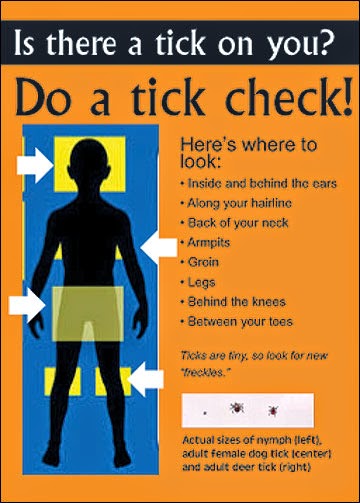
While out hiking or camping with friends, or even by yourself, stop to check over your body and clothing periodically for ticks. Once you get home from the outdoors, wash your clothes and keep an eye on your body for the next three days. With the development of good habits, there’s no need for paranoia when it comes to spending time outdoors. Being aware of your surroundings and of the proper treatments will allow you to traverse the wild with peace of mind.
 |
| Rubio Canyon. 3/1/2011 - The day I was bit. |
Don’t Burn the Tick!
After discovering the engorged tick sticking out of my back near my left armpit, my first mistake was burning it dead before trying to yank it out. I thought nothing of following this conventional wisdom, but am now convinced this was the action that ensured my infection. When you burn a tick, it’s saliva is spewed into your wounded skin, elevating risk of infection. Normally, a tick must be attached for 36-48 hours before the Lyme bacteria transmits. Infection with the Lyme bacteria is slim before this window. Burning the tick before then greatly increases odds of infection.
 |
| The proper method! |
The proper way to remove a tick is to use tweezers and try to pull it out from as close to the head as possible. If you cannot remove the tick entirely, seek medical assistance. After failing to remove a tick that attached near my collarbone earlier this year, I had it removed at a local urgent care. They sent it to be tested in a lab for peace of mind - it came back negative for Lyme.
Watch for Signs of Infection
If you’ve managed to remove the embedded tick within that 36 hour window in it’s entirety, disinfect the area and allow it to heal. Save the removed tick in case future testing is warranted. Keep an eye out for the tell-tale sign of Lyme infection - Erythema migrans, or a "bull’s-eye" rash. This rash occurs in 70-80% of those infected. If you see the rash develop, or feel symptoms of malaise, sore throat, fever, chills or fatigue, get yourself to your doctor immediately.
 |
| Bull’s-eye rash |
Accept Antibiotics!
When I contracted Lyme, my second mistake after burning the tick was refusing antibiotics. After removing the tick I had burned, my doctor offered me a couple of days worth of doxycycline as a profilactic measure against infection. Being generally weary of antibiotics, I refused.
Unfortunately for me, my doctor failed to make clear that your immune system CANNOT overcome a Lyme infection. About six days later I had a sore throat. Eight days later I had an itchy bullseye rash, horrible malaise, and was put on two weeks worth of doxycycline. The antibiotics affected me worse than the Lyme, but within a few days the rash began to fade.
Don’t Believe The Internet
There’s a lot of crazy information online about Lyme Disease. I learned that the hard way. Google led me to plenty of pages promoting conspiracy-type views about Lyme being incurable, even after early treatment with antibiotics. These pages asserted that doctors were all in on an evil plot to deny chronic Lyme patients antibiotics, and pretty much told me I was screwed forever.
I gradually learned to avoid the webpages with flashing neon lights, and to rely upon more credible sources such as WebMD and Mayo Clinic. Although untreated Lyme Disease can have devastating effects, those catching and treating an early infection should expect to be cured completely.
After my experience with Lyme Disease, I began taking the following precautions to reduce my chances of future contact with ticks:
Ticks can crawl up your pant legs, up your shirt, down your neck… Take this into consideration. For a while, I only wore long pants and tucked-in, white, long sleeve shirts while out in the mountains. Some researchers even tuck their pants into their socks and wrap them with tape! Wearing light colors helps you to spot ticks and brush them off, while wearing tucked-in, long sleeved clothing provides fewer entry points for crawling critters.
 |
| The author, at left - Dressed for Ticks! |
Stay on Trails
The tick that infected me with Lyme went straight down my shirt collar as I climbed through the bushes. Needless to say, I don’t go bushwhacking anymore! Ticks like to reach out from tall grasses and attach to creatures that brush on by. You can avoid this prime tick habitat by staying in the center of trails and by trying not to brush up against shrubs and grasses.
Check for Ticks
It is impossible to completely avoid ticks, and many of us would prefer not to spray ourselves with insect repellant every time we go out into the woods. Tick checks, I’ve found, are the best option for reducing the risk of exposure.
While out hiking or camping with friends, or even by yourself, stop to check over your body and clothing periodically for ticks. Once you get home from the outdoors, wash your clothes and keep an eye on your body for the next three days. With the development of good habits, there’s no need for paranoia when it comes to spending time outdoors. Being aware of your surroundings and of the proper treatments will allow you to traverse the wild with peace of mind.
 |
| The author - Eagle Rock, Topanga Canyon |
Sunday, May 25, 2014
My Help is in the Mountain
The following poem came up on my Facebook news feed a few days ago and really moved me. It expresses the healing that be gained from belonging to a place and becoming one with the land.

My help is in the mountain
Where I take myself to heal
The earthly wounds
That people give to me.
I find a rock with sun on it
And a stream where the water runs gentle
And the trees which one by one give me company.
So must I stay for a long time
Until I have grown from the rock
And the stream is running through me
And I cannot tell myself from one tall tree.
Then I know that nothing touches me
Nor makes me run away.
My help is in the mountain
That I take away with me.
The earthly wounds
That people give to me.
I find a rock with sun on it
And a stream where the water runs gentle
And the trees which one by one give me company.
So must I stay for a long time
Until I have grown from the rock
And the stream is running through me
And I cannot tell myself from one tall tree.
Then I know that nothing touches me
Nor makes me run away.
My help is in the mountain
That I take away with me.
-Nancy Wood
When I read this poem I am reminded of the hills, canyons, steams and trails which are my healing places. I think of how so many people have lost a spiritual relationship with the land they inhabit; of how the world’s problems could be resolved if we would only set down roots. Therefore I ask - to what land do you belong? Where are your healing places?
Sunday, March 30, 2014
Out With The Big Sagebrush
This past Friday, I really needed to take a mental health day. I found myself wanting to get out into the sagebrush and pine trees, to a place that reminds me of my Uncle Bob’s property in the Eastern Sierras. I decided to drive for about an hour up Angeles Crest, and hike a section of the Silver Moccasin Trail I’d explored before with a friend near Mount Waterman in the Angeles National Forest.

If you drive far enough up the highway to the desert side of the mountains, the plants begin to change. You’ll begin to encounter a plant which grows in abundance at my Uncle’s place in Sierra Valley - Big Sagebrush (Artemesia tridentata)

Big sagebrush is an important plant. It can be used for purification in the sweat lodge, disinfection, and to cure colds and stomachaches, along with many other traditional uses. While last at my uncle’s place during New Year, I wandered his property, and walked through the abundant sagebrush. I collected a small amount which I bundled and gave to relatives, and kept one for myself which now hangs on my kitchen cabinet.

Now, whenever I need a moment of peace, I take a deep breath of the fragrant bundle and am transported back to the beauty of Sierra Valley where it covers the landscape and perfumes the air. I am reminded of the rustic comfort of my uncle's land, which has become a cherished place for all of my family. And on this last hike of mine, I realized that this is a plant that I am developing a special relationship with.
If you drive far enough up the highway to the desert side of the mountains, the plants begin to change. You’ll begin to encounter a plant which grows in abundance at my Uncle’s place in Sierra Valley - Big Sagebrush (Artemesia tridentata)
Big sagebrush is an important plant. It can be used for purification in the sweat lodge, disinfection, and to cure colds and stomachaches, along with many other traditional uses. While last at my uncle’s place during New Year, I wandered his property, and walked through the abundant sagebrush. I collected a small amount which I bundled and gave to relatives, and kept one for myself which now hangs on my kitchen cabinet.
Now, whenever I need a moment of peace, I take a deep breath of the fragrant bundle and am transported back to the beauty of Sierra Valley where it covers the landscape and perfumes the air. I am reminded of the rustic comfort of my uncle's land, which has become a cherished place for all of my family. And on this last hike of mine, I realized that this is a plant that I am developing a special relationship with.
 |
| Out with the Big Sagebrush - Sierra Valley, CA |
Sunday, March 2, 2014
First Overnight In The Angeles
It was mid January of 2009 when I departed for my first overnight journey into the mountains. I had been hiking the trails often, and had been wanting to camp overnight for some time. I felt different when I was out on the trail… free and strong. I was comfortable by now in these mountains, and wanted to know what it would be like to take it one step further and stay overnight.
This was to be an adventure! I had a tent, sleeping bag, book, instant miso soup and cooked brown rice, water bottles, granola bars, and tortillas. I began from the Chaney Trail parking lot in Millard Canyon - my favorite place to take off into the mountains. Following a quick smoke, I placed my Adventure Pass in the window, and was off.
It’s always exciting hiking up the trail through the oak-covered hills and above the stream of Millard Canyon. Though it felt the same as the hikes I’d make into this canyon before, I knew this time I wouldn’t be coming home at the end of the day. I’d be out there. Outside.
I’d hiked the Sunset Ridge trail so many times by then that I fail to recall any significant difference in my enjoyment of the sights and smells of native California during this particular trip. I only remember knowing that this time I’d wake up in the forest! It seemed an adventure indeed, and I felt pretty bad-ass when chatting with a group of young hikers I met while taking a pause to eat some tortillas at Dawn Station - an old station of the former Mt. Lowe Railway.

I had been up to that point before and higher, having reached the Mt. Lowe Campground at least once before. I was encouraged when I reached the timberline not much further above, knowing that I was coming upon the last stretch of my journey. I passed Granite Gate, and took a picture of it with my cellphone. I studied all of all of the old-time photos on display boards. Signage and pictures of other landmark passings were posted all the way up to the campground.

Once I finally arrived at the campground, I was relieved to find that I was the only one there. I rested my pack on a bench-table seat and sat to enjoy a snack following my exertions. What a feeling I had, while my legs were swinging on that bench and I was eating my sandwich. Looking out over the trees in the afternoon sunlight and knowing that I was free! That I was here! That I had nowhere else to be!
I had reached the campground and took time to read it's informative historical exhibits, but my goal was to reach the nearby summit of Mt. Lowe that day. Not wanting to lug as heavy a pack as I had been carrying further, I climbed into the woods on the hillside above the ruins of the old resort and stashed my tent and sleeping bag behind a tree.
This was all new country to me now, and I passed first the site of old cottages that had housed guests and maids of the resort as far back as the 1800s. When finally I reached the summit of Mt. Lowe, I admired the pictures of Professor Thaddeus Lowe and some other old-timers in fine dress on the summit of the former Oak Mountain (later renamed for Lowe.)

I ignored the group of eight or so affluent-looking folks (who had obviously walked in from the nearby Mt. Wilson Road) and gazed out upon the horizon and to the valley below. I actually managed to text my brother from that height and let him know that I’d made it! It was good to receive his response, and I admired and explored the peak a while longer.
By the time I arrived at the campground and had retrieved my stashed goods, it was almost dark and I had yet to make camp and forage for firewood. I had not expected that I would be allowed to make a campfire. It was my first time camping, and I guess this city boy expected the rules to be more stringent! I was pleasantly surprised to find the fire-rings, but found myself now scurrying about in near-darkness trying to scavenge enough dead and cut branches to maintain a fire.
Luckily, there was an abundance of dead branches piled up - native shrubs and manzanita wood that had been cleared and piled on the side of the fire road to the camp. I gathered the remainder of my wood in the dark with the aid of a miniature LED flashlight and felt rather light and energetic running about in the brisk evening air. Perhaps the feeling of lightness was because I no longer carried a heavy pack strapped to my back.
The surrounding hillsides and peaks had grown dark by the time I huddled near the campfire. The stars were out, and the ruins of the old resort were dark and empty as the light of my fire flickered against it’s walls. I made some tea and munched on trail mix, though I distinctly recall not being able to sit down and relax near my fire as I would have liked, for I was continually getting up to feed it. I was walking my tired body around different sides of the flame with my bandana over my nose and mouth like a bandito, trying to avoid the shifting direction of the smoke that burned my eyes.
I sat near the edge of the fire pit for a while trying to read the book I’d brought by firelight, but it was never long until I had to get back up to again feed the flames. Eventually, sooner than I would have liked, I decided it was time to go into my tent and abandon the embering pit. I hung my little flashlight in my tent and unrolled my sleeping bag. I laid down on top of it and felt that I could have fallen asleep right then and there.
I roused myself up into a sitting position under my light to read a bit. The book I’d brought with me was one which I had just received for Christmas entitled “Sacred Plant Medicine: The Wisdom In Native American Herbalism.” A seemingly fitting book for a night in the forest. Hours passed as the cold wind whistled through my tent. The haunting photographs of long-dead medicine people stared somberly at me through the depths of time as I read of the connection and relationships between humans and plants, and of the knowledge that can be gained firsthand from plants.

The chapters began to meld into one another and reading grew more tiresome. I turned out the light and settled into my sleeping bag in the pitch-blackness of my tent. The darkness let up as my eyes became adjusted, but the cold and wind did not. My tent was pitched on a gradual slope atop many roots and rocks; outside there were noises… I forced myself out of the tent once past midnight to relieve myself. Facing the dark old ruins, I had some fear of ghosts. I reminded myself that this resort had been a place of joy. I didn’t sleep much at all that night.
I arose exhausted early in the morning and cooked a breakfast of oatmeal on my little camp stove. The trip had been great so far (except for the not-sleeping and being frozen part of it!) I wanted to see Inspiration Point, for it was nearby and I’d never been. I hiked up to the structure through the beautiful manzanita bushes and peered out from the high up view.

Just as from the top of Mount Lowe, the recognizable landmarks below seemed especially small. I could see Pasadena City Hall, Los Angeles City Hall, and everything in between. I could see Catalina Island far out on this overcast day, and felt as if I could see the curvature of the Earth. There was hustling and bustling going on in the civilization below, but I couldn’t hear it. All I heard was the wind running through the branches.
I turned around and walked back upon the familiar trail. It was time to return to that concrete world of electronics and automobiles. But a new chapter of my life had begun. Forever after, looking up to the looming peaks from the city below, I would always remember that experience. I’d spent a night in the Angeles, and the mountains were now that much more a part of me.
This was to be an adventure! I had a tent, sleeping bag, book, instant miso soup and cooked brown rice, water bottles, granola bars, and tortillas. I began from the Chaney Trail parking lot in Millard Canyon - my favorite place to take off into the mountains. Following a quick smoke, I placed my Adventure Pass in the window, and was off.
 |
| The Sunset Ridge Trail |
It’s always exciting hiking up the trail through the oak-covered hills and above the stream of Millard Canyon. Though it felt the same as the hikes I’d make into this canyon before, I knew this time I wouldn’t be coming home at the end of the day. I’d be out there. Outside.
I’d hiked the Sunset Ridge trail so many times by then that I fail to recall any significant difference in my enjoyment of the sights and smells of native California during this particular trip. I only remember knowing that this time I’d wake up in the forest! It seemed an adventure indeed, and I felt pretty bad-ass when chatting with a group of young hikers I met while taking a pause to eat some tortillas at Dawn Station - an old station of the former Mt. Lowe Railway.
I had been up to that point before and higher, having reached the Mt. Lowe Campground at least once before. I was encouraged when I reached the timberline not much further above, knowing that I was coming upon the last stretch of my journey. I passed Granite Gate, and took a picture of it with my cellphone. I studied all of all of the old-time photos on display boards. Signage and pictures of other landmark passings were posted all the way up to the campground.
Once I finally arrived at the campground, I was relieved to find that I was the only one there. I rested my pack on a bench-table seat and sat to enjoy a snack following my exertions. What a feeling I had, while my legs were swinging on that bench and I was eating my sandwich. Looking out over the trees in the afternoon sunlight and knowing that I was free! That I was here! That I had nowhere else to be!
 |
| Mt. Lowe Campground 1/14 |
I had reached the campground and took time to read it's informative historical exhibits, but my goal was to reach the nearby summit of Mt. Lowe that day. Not wanting to lug as heavy a pack as I had been carrying further, I climbed into the woods on the hillside above the ruins of the old resort and stashed my tent and sleeping bag behind a tree.
 |
| Ye Alpine Tavern - the current site of Mt. Lowe Campground |
This was all new country to me now, and I passed first the site of old cottages that had housed guests and maids of the resort as far back as the 1800s. When finally I reached the summit of Mt. Lowe, I admired the pictures of Professor Thaddeus Lowe and some other old-timers in fine dress on the summit of the former Oak Mountain (later renamed for Lowe.)
I ignored the group of eight or so affluent-looking folks (who had obviously walked in from the nearby Mt. Wilson Road) and gazed out upon the horizon and to the valley below. I actually managed to text my brother from that height and let him know that I’d made it! It was good to receive his response, and I admired and explored the peak a while longer.
 |
| Oak Mountain, near the summit. |
By the time I arrived at the campground and had retrieved my stashed goods, it was almost dark and I had yet to make camp and forage for firewood. I had not expected that I would be allowed to make a campfire. It was my first time camping, and I guess this city boy expected the rules to be more stringent! I was pleasantly surprised to find the fire-rings, but found myself now scurrying about in near-darkness trying to scavenge enough dead and cut branches to maintain a fire.
Luckily, there was an abundance of dead branches piled up - native shrubs and manzanita wood that had been cleared and piled on the side of the fire road to the camp. I gathered the remainder of my wood in the dark with the aid of a miniature LED flashlight and felt rather light and energetic running about in the brisk evening air. Perhaps the feeling of lightness was because I no longer carried a heavy pack strapped to my back.
The surrounding hillsides and peaks had grown dark by the time I huddled near the campfire. The stars were out, and the ruins of the old resort were dark and empty as the light of my fire flickered against it’s walls. I made some tea and munched on trail mix, though I distinctly recall not being able to sit down and relax near my fire as I would have liked, for I was continually getting up to feed it. I was walking my tired body around different sides of the flame with my bandana over my nose and mouth like a bandito, trying to avoid the shifting direction of the smoke that burned my eyes.
 |
| Cell phone pic of my first campfire! |
I sat near the edge of the fire pit for a while trying to read the book I’d brought by firelight, but it was never long until I had to get back up to again feed the flames. Eventually, sooner than I would have liked, I decided it was time to go into my tent and abandon the embering pit. I hung my little flashlight in my tent and unrolled my sleeping bag. I laid down on top of it and felt that I could have fallen asleep right then and there.
I roused myself up into a sitting position under my light to read a bit. The book I’d brought with me was one which I had just received for Christmas entitled “Sacred Plant Medicine: The Wisdom In Native American Herbalism.” A seemingly fitting book for a night in the forest. Hours passed as the cold wind whistled through my tent. The haunting photographs of long-dead medicine people stared somberly at me through the depths of time as I read of the connection and relationships between humans and plants, and of the knowledge that can be gained firsthand from plants.
The chapters began to meld into one another and reading grew more tiresome. I turned out the light and settled into my sleeping bag in the pitch-blackness of my tent. The darkness let up as my eyes became adjusted, but the cold and wind did not. My tent was pitched on a gradual slope atop many roots and rocks; outside there were noises… I forced myself out of the tent once past midnight to relieve myself. Facing the dark old ruins, I had some fear of ghosts. I reminded myself that this resort had been a place of joy. I didn’t sleep much at all that night.
I arose exhausted early in the morning and cooked a breakfast of oatmeal on my little camp stove. The trip had been great so far (except for the not-sleeping and being frozen part of it!) I wanted to see Inspiration Point, for it was nearby and I’d never been. I hiked up to the structure through the beautiful manzanita bushes and peered out from the high up view.
Just as from the top of Mount Lowe, the recognizable landmarks below seemed especially small. I could see Pasadena City Hall, Los Angeles City Hall, and everything in between. I could see Catalina Island far out on this overcast day, and felt as if I could see the curvature of the Earth. There was hustling and bustling going on in the civilization below, but I couldn’t hear it. All I heard was the wind running through the branches.
 |
| The author revisiting his first campsite. Mt. Lowe Campground 1/14 |
I turned around and walked back upon the familiar trail. It was time to return to that concrete world of electronics and automobiles. But a new chapter of my life had begun. Forever after, looking up to the looming peaks from the city below, I would always remember that experience. I’d spent a night in the Angeles, and the mountains were now that much more a part of me.
Subscribe to:
Posts (Atom)