Thursday, July 3, 2014

Eaton Canyon Closure and the National Recreation Area Bill

There has been some public outcry in response to recent reports that the Forest Service is to close a dangerous portion of Eaton Canyon.  As someone who loves exploring the local mountains, I understand that restricted access to our open space can be troubling.  However, I also find myself avoiding several once-beautiful open spaces which have now become trashed and destroyed.  Eaton Canyon is quickly becoming one of them.


During my last visit to Eaton Canyon, I witnessed several inexperienced climbers heading up the cliff to the second waterfall.  More troubling was the amount of plastic trash and graffiti left behind.  Plastic bottles, caps, straws and bags floated in the pool below the falls, spoiling any experience of nature.


It became apparent to me that in order to preserve and protect the waterfall at Eaton Canyon, access needed to be either completely restricted, or allowed under the supervision of patrolling park rangers or some other type of authority.  Without some type of regular supervision and maintenance within this easily-accessable natural area, Eaton Canyon will remain a place where littering, graffiti, and other irresponsible behaviors are carried out with blatant disregard for any law or sign.


Major graffiti damage to Eaton Canyon

Perhaps, as I have discussed with others concerned about the area, the National Recreation Area bill which has been submitted to Congress could help being improved visitor services and more rangers to the San Gabriel Mountains.  Permits could be issued to ensure that experienced canyoneers are granted access.  If such improvements can help stem the tide of pollution, graffiti, trail closures and general neglect of the Angeles National Forest, then this is a bill we should all hope will pass.

Saturday, June 7, 2014

Lyme Disease in the San Gabriel Mountains

Spring is here, and Summer lies not far behind.  It's the time of year in which the grasses grow tall along the trails and fields, and which draws people outdoors for active recreation.  This warm, expansive energy also spurs various species of ticks into activity; bringing with them the risk for contracting a much feared bacterial infection - Lyme Disease.

Rubio Canyon.  3/1/2011 - The day I was bit.
Here in California, the western blacklegged tick is the species that can transmit the bacteria which causes Lyme Disease.  This bacteria, Borrelia burgdorferi, is transmitted to humans through the bite of infected ticks.  I was bitten and infected with Lyme Disease in March of 2011 while bushwhacking up the ruins of the Great Incline in Rubio Canyon.  Let me share with you my personal experience with Lyme Disease, the mistakes that I made, and the advice I can offer as someone who’s gone through it.

Don’t Burn the Tick!

After discovering the engorged tick sticking out of my back near my left armpit, my first mistake was burning it dead before trying to yank it out.  I thought nothing of following this conventional wisdom, but am now convinced this was the action that ensured my infection.  When you burn a tick, it’s saliva is spewed into your wounded skin, elevating risk of infection.  Normally, a tick must be attached for 36-48 hours before the Lyme bacteria transmits.  Infection with the Lyme bacteria is slim before this window.  Burning the tick before then greatly increases odds of infection.

The proper method!

The proper way to remove a tick is to use tweezers and try to pull it out from as close to the head as possible.  If you cannot remove the tick entirely, seek medical assistance.  After failing to remove a tick that attached near my collarbone earlier this year, I had it removed at a local urgent care.  They sent it to be tested in a lab for peace of mind - it came back negative for Lyme.

Watch for Signs of Infection

If you’ve managed to remove the embedded tick within that 36 hour window in it’s entirety, disinfect the area and allow it to heal.  Save the removed tick in case future testing is warranted.  Keep an eye out for the tell-tale sign of Lyme infection - Erythema migrans, or a "bull’s-eye" rash.  This rash occurs in 70-80% of those infected.  If you see the rash develop, or feel symptoms of malaise, sore throat, fever, chills or fatigue, get yourself to your doctor immediately.

Bull’s-eye rash

Accept Antibiotics!  

When I contracted Lyme, my second mistake after burning the tick was refusing antibiotics.  After removing the tick I had burned, my doctor offered me a couple of days worth of doxycycline as a profilactic measure against infection.  Being generally weary of antibiotics, I refused.

Unfortunately for me, my doctor failed to make clear that your immune system CANNOT overcome a Lyme infection.  About six days later I had a sore throat.  Eight days later I had an itchy bullseye rash, horrible malaise, and was put on two weeks worth of doxycycline.  The antibiotics affected me worse than the Lyme, but within a few days the rash began to fade.

Don’t Believe The Internet

There’s a lot of crazy information online about Lyme Disease.  I learned that the hard way.  Google led me to plenty of pages promoting conspiracy-type views about Lyme being incurable, even after early treatment with antibiotics.  These pages asserted that doctors were all in on an evil plot to deny chronic Lyme patients antibiotics, and pretty much told me I was screwed forever.


I gradually learned to avoid the webpages with flashing neon lights, and to rely upon more credible sources such as WebMD and Mayo Clinic.  Although untreated Lyme Disease can have devastating effects, those catching and treating an early infection should expect to be cured completely.

After my experience with Lyme Disease, I began taking the following precautions to reduce my chances of future contact with ticks:

Dress Appropriately 

Ticks can crawl up your pant legs, up your shirt, down your neck…  Take this into consideration.  For a while, I only wore long pants and tucked-in, white, long sleeve shirts while out in the mountains.  Some researchers even tuck their pants into their socks and wrap them with tape!  Wearing light colors helps you to spot ticks and brush them off, while wearing tucked-in, long sleeved clothing provides fewer entry points for crawling critters.

The author, at left - Dressed for Ticks!

Stay on Trails

The tick that infected me with Lyme went straight down my shirt collar as I climbed through the bushes.  Needless to say, I don’t go bushwhacking anymore!  Ticks like to reach out from tall grasses and attach to creatures that brush on by.  You can avoid this prime tick habitat by staying in the center of trails and by trying not to brush up against shrubs and grasses.


Check for Ticks

It is impossible to completely avoid ticks, and many of us would prefer not to spray ourselves with insect repellant every time we go out into the woods.  Tick checks, I’ve found, are the best option for reducing the risk of exposure.


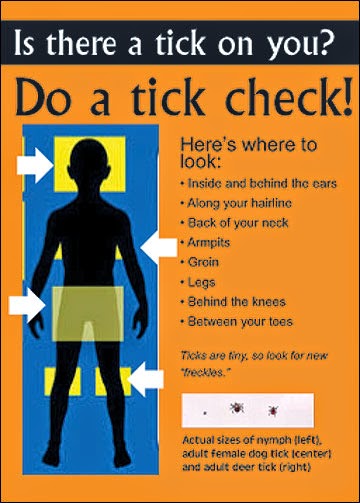
While out hiking or camping with friends, or even by yourself, stop to check over your body and clothing periodically for ticks.  Once you get home from the outdoors, wash your clothes and keep an eye on your body for the next three days.  With the development of good habits, there’s no need for paranoia when it comes to spending time outdoors.  Being aware of your surroundings and of the proper treatments will allow you to traverse the wild with peace of mind.

The author - Eagle Rock, Topanga Canyon

Sunday, May 25, 2014

My Help is in the Mountain

The following poem came up on my Facebook news feed a few days ago and really moved me.  It expresses the healing that be gained from belonging to a place and becoming one with the land.


My help is in the mountain
Where I take myself to heal
The earthly wounds
That people give to me.
I find a rock with sun on it
And a stream where the water runs gentle
And the trees which one by one give me company.
So must I stay for a long time
Until I have grown from the rock
And the stream is running through me
And I cannot tell myself from one tall tree.
Then I know that nothing touches me
Nor makes me run away.
My help is in the mountain
That I take away with me. 

-Nancy Wood

When I read this poem I am reminded of the hills, canyons, steams and trails which are my healing places.  I think of how so many people have lost a spiritual relationship with the land they inhabit; of how the world’s problems could be resolved if we would only set down roots.  Therefore I ask - to what land do you belong?  Where are your healing places?

Thursday, April 10, 2014

Tales of Mexican California

It’s interesting how some things from your childhood can be viewed with entirely new eyes as an adult.  That’s been the case for me in rereading a book from my past entitled Tales of Mexican California.


Tales of Mexican California is a firsthand account of the experiences of Antonio Coronel, a Californio who arrived in the Mexican territory as a youth in 1834.  Dictated in Spanish to an assistant of historian Hubert Howe Bancroft in 1877, it brings to life the people, places, and happenings of a bygone era.

When my dad first gave me this book as a young kid in grade school, he flipped through the pages with me and showed me the pictures.  “Look, chingasos!”  he said as he left me with the book, opened to a drawing of an early California brawl.  That piqued my interest enough to read of it what I could, and the illustrations were indeed suited to a young boy’s imagination.

“Look, chingasos!"

Though I found the heritage of the Spanish-speaking peoples of this land interesting, and related to it as my own, it was not until recently that I discovered the reason it was so difficult for me to read the book beyond it’s pictures:  Despite it’s cartoonish illustrations, this is a legitamate historical account!  Hardly the stuff a child could comprehend.

What I find so fascinating about reading this book as an adult is that it all takes place in country I’m familiar with.  It’s a look back in time to the land I call home.  Coronel’s family home was Rancho Canada atras de Rancho los Verdugos - the modern day cities of La Canada and La Crescenta.  That’s right up the road from me - I went to high school in La Canada!

Who knew that there were battles against American invaders - right there in the Pueblo of Los Angeles?  Coronel gives an exciting account of this campaign, along with many other of his adventures up until the days of the Gold Rush an early California statehood.

“I knew the Sonoran desert well, and realized it was a risky move, because Flores did not have sufficient provisions.  Although my friends and I were well-provisioned and could share in a pinch, there wouldn’t be much to go around.  Many of the Californians gave me to understand that they were sure I would get them out of any trouble, with my knowledge of the country.  More than anything, this convinced me not to accompany Flores, although my men said they would follow me anywhere.

… I advised them that we should all turn back and wait the course of events in California, while hiding out in the sierra.  If we were pursued, we could still go to Sonora in time."

“… We went by the sierra of San Bernardino, walking all night…  We ran into a storm of snow, rain and wind so violent we couldn’t see each other.  The soldiers… scattered in the brush looking for shelter, covering their backs with saddle blankets…  Fortune helped with a lull in the storm, and I got a huge bonfire going…  When we were all together I told them these hardships were the beginning of the guerrilla life, or that of any wanderer of the sierras…  I proposed we go to the nearest ranch - Cucamonga - and find out what had happened while we were gone…"

Throughout his life, Coronel was a friend and advocate of the Indians and held several distinguished positions.  His account in Tales of Mexican California provides sections on life in the missions, and Californio daily life, culture and customs - including fandangoes, songs and dress - along with accounts of outlaws and banditos.

Photo of Don Antonio F. Coronel

The very fact that these stories take place in such familiar environs to us residents of the Southland - including Rancho del Chino, San Diego, San Gabriel, Los Angeles and Ventura makes this a very exciting account indeed, and well worth a read for anyone looking to connect in a very human way to Southern California’s rich and fascinating past.


Saturday, April 5, 2014

Traditional Aztec Dietary Advice

In preparation for my first cooking class, Cooking With Native American Foods, I compiled a list of foods and herbs which comprise of some of the greatest gastronomic contributions of North and South America to the world.


In reviewing different sources of information to include in this concise list, I was reminded of an excerpt from the traditional Aztec advice given from father to son regarding the proper way of eating.

"Listen! Above all you are to be prudent in drink, in food, for many things pertain to it. You are not to eat excessively of the required food. And when you do something, when you perspire, when you work, it is necessary that you break your fast. Furthermore, the courtesy, the prudence you should show are in this wise: when you are to eat, you are not to be hasty, not to be impetuous; you are not to take excessively nor to break up your tortillas. You are not to put a large amount in your mouth; you are not to swallow it unchewed. You are not to gulp like a dog, when you are to eat food… You are to drink, eat slowly, calmly, quietly.”


I find it interesting how closely the pre-Cortesian practice of eating moderately and mindfully parallels the traditional Okinawan way of eating.  Okinawa is one of the world’s longevity hotspots, with many of it’s longtime residents living to be centenarians.  The residents of this so-called Blue Zone follow the age-old Japanese macrobiotic advice of “hara hachi bu.”  "Hara hachi bu” means to eat until you are 80 percent full.  


Just as in ancient Mexico, the Eastern practice of mindfulness and gratefulness with respect to eating demonstrates the profound importance of not only the quality of the food taken during meals, but the manner in which those meals are consumed.  Indeed, the Spanish conquerors of Mexico were astonished at the deliberate and solemn manner in which the Indians ate.  Combining such practices today along with a return to the indigenous diets of the world would yield immeasurable health benefits for our modern society.

Sunday, March 30, 2014

Out With The Big Sagebrush

This past Friday, I really needed to take a mental health day.  I found myself wanting to get out into the sagebrush and pine trees, to a place that reminds me of my Uncle Bob’s property in the Eastern Sierras.  I decided to drive for about an hour up Angeles Crest, and hike a section of the Silver Moccasin Trail I’d explored before with a friend near Mount Waterman in the Angeles National Forest.


If you drive far enough up the highway to the desert side of the mountains, the plants begin to change.  You’ll begin to encounter a plant which grows in abundance at my Uncle’s place in Sierra Valley - Big Sagebrush (Artemesia tridentata)


Big sagebrush is an important plant.  It can be used for purification in the sweat lodge, disinfection, and to cure colds and stomachaches, along with many other traditional uses.  While last at my uncle’s place during New Year, I wandered his property, and walked through the abundant sagebrush.  I collected a small amount which I bundled and gave to relatives, and kept one for myself which now hangs on my kitchen cabinet.


Now, whenever I need a moment of peace, I take a deep breath of the fragrant bundle and am transported back to the beauty of Sierra Valley where it covers the landscape and perfumes the air.  I am reminded of the rustic comfort of my uncle's land, which has become a cherished place for all of my family.  And on this last hike of mine, I realized that this is a plant that I am developing a special relationship with.


Out with the Big Sagebrush - Sierra Valley, CA

Wednesday, March 19, 2014

Oh Happy Days

Please allow me to introduce you to one of my favorite spots, located in the heart of Altadena, CA - Oh Happy Days Healthfood Cafe & Market!  


What is it like to visit Oh Happy Days you might ask?  Well, imagine going to your grandfather's house for some good, home-style cooking, except that your grandfather is vegan and knows a lot about health.  


That's what you can expect at Oh Happy Days.  It's rustic food is pure, hearty, nutritious and filling.  You can't go wrong with the soup!  With brown rice, beans and vegetables, it's a full meal in itself for less than 3 bucks... and all organic!!!  The Lomein noodles are also good. 


 I discovered this place one night several years ago, when I stopped by with my mom to purchase some supplements.  Opening the door for the first time, I was met by the turning heads of the locals who were sitting at communal wooden tables over steaming hot plates of food.  The owner was very friendly, and I didn’t fail to notice the hand-painted sign on the front window advertising a bowl of vegetable soup - for a mere $2.50!  

The heart and soul of Altadena 

Upon my second visit there, I decided that the soup was too good a bargain to resist.  On this day, the sunlight brightened up the store’s yellow painted walls, and the classical music playing in the background created quite a cheerful atmosphere indeed.  There were African paintings, statues on display, buddhist prayer flags, and interesting things to look at all around.  A truly worldly place, the cafe walls displayed an eclectic mixture of cultures and influences.  I tried the soup, loved it, and have been coming back ever since.  

Oh Happy Days has become a place where I feel comfortable passing the time. It’s the kind of place where strangers will introduce themselves and start a conversation with you.  It’s a place that brings people from all different races, ages, and backgrounds together.  

Someone caught me in a pic!  The author, at center - a regular at “John’s"

Like everyone who frequents this establishment, I became friends with the owner, John - who is one of the best people I know and an inspiration to me.  A vegan for over 30 years, John has run his store in Altadena for about as long.  Now in his sixties, he goes on long bike rides, cooks all of the food, and works tirelessly maintaining this peaceful little spot - a true gift to the community.

John

For the highly affordable price, John's homestyle cooking really hits the spot.  Oh Happy Days is a community gathering place, and John is such a caring guy.  I've seen him give a free bowl of soup to the homeless before, and get the sense that he helps a lot of people out.  Definitely a place worth supporting!